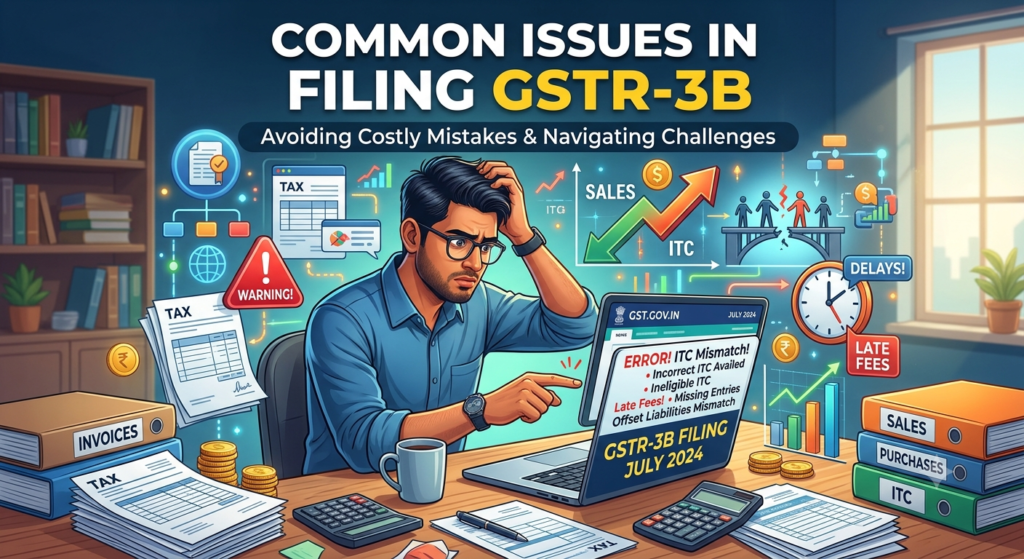
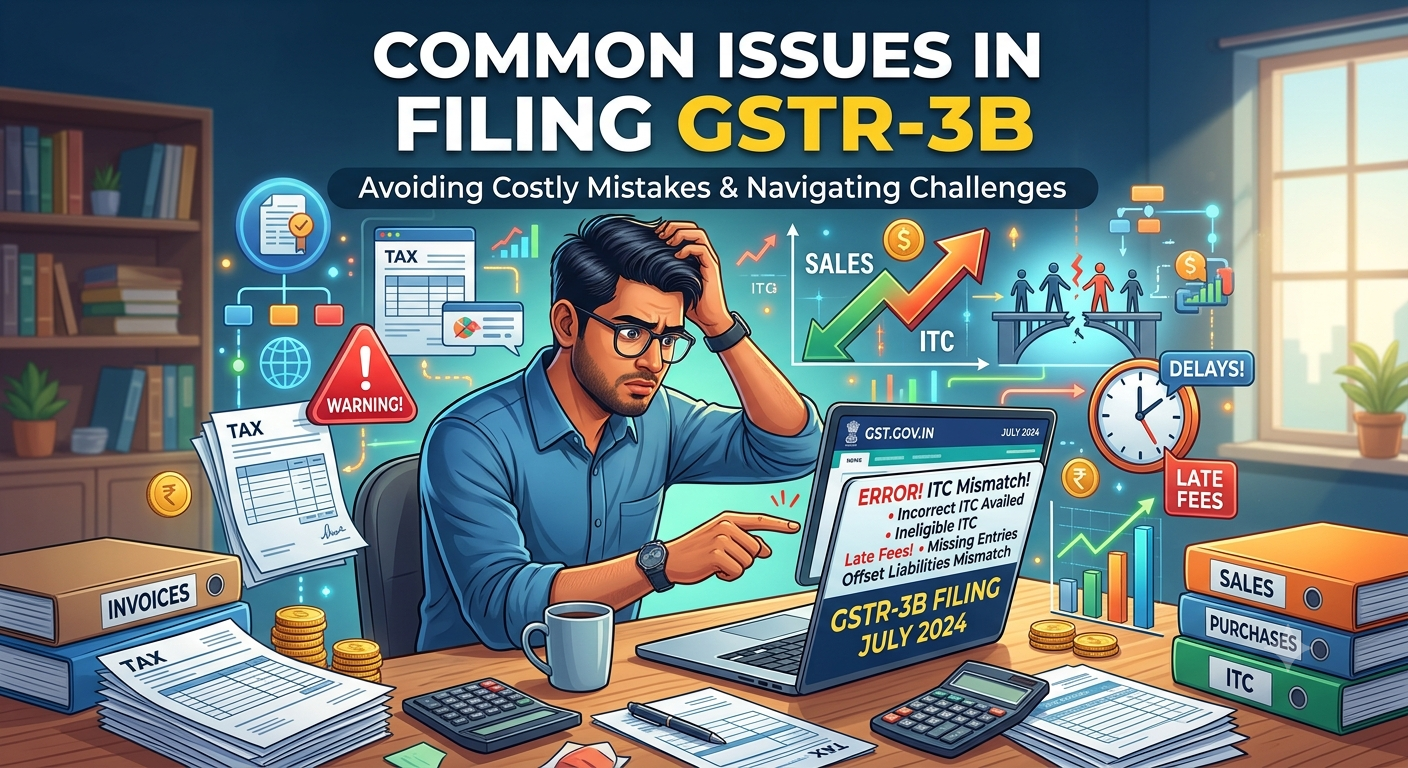
Common Issues in Filing GSTR-3B and How to Avoid Them
Filing GSTR-3B is a crucial monthly or quarterly compliance requirement for businesses registered under the Goods and Services Tax (GST) regime in India. Since GSTR-3B is a self-declared summary return, even minor errors can result in tax demands, notices, interest, penalties, or difficulties in claiming Input Tax Credit (ITC).
Understanding the most common filing issues and adopting best practices can help businesses remain compliant and avoid unnecessary complications.
1. Mismatch Between GSTR-1 and GSTR-3B
One of the most frequent issues arises when the details reported in GSTR-1 do not match the figures declared in GSTR-3B. Differences in taxable value, tax liability, or amendments may trigger notices from the GST department.
How to avoid it:
- Reconcile sales data before filing.
- Compare outward supplies reported in GSTR-1 with tax liability in GSTR-3B.
- Review amendments carefully before submission.
2. Incorrect Reporting of Input Tax Credit (ITC)
Businesses often claim excess ITC, miss eligible credits, or report ITC under incorrect categories. Such errors can lead to reversals, interest liability, and departmental scrutiny.
How to avoid it:
- Reconcile purchase records with GSTR-2B.
- Verify supplier compliance before claiming ITC.
- Maintain proper documentation for all purchases.
3. Errors in Tax Liability Calculation
Incorrect tax calculations may occur due to classification errors, wrong GST rates, or omission of taxable transactions. Underpayment attracts interest, while overpayment affects working capital.
How to avoid it:
- Use updated GST rates.
- Verify tax computations through accounting software.
- Review tax liability before filing.
4. Wrong Reporting Under IGST, CGST, and SGST
Taxpayers sometimes report interstate supplies as intrastate supplies or vice versa, resulting in incorrect tax payments.
How to avoid it:
- Verify the place of supply.
- Confirm customer GSTIN and business location.
- Cross-check invoices before filing.
5. Missing Reverse Charge Transactions
Businesses liable to pay GST under the Reverse Charge Mechanism (RCM) may overlook eligible transactions, resulting in non-payment of tax.
How to avoid it:
- Maintain a separate register for RCM transactions.
- Review expenses such as legal fees, freight, and specified notified services.
- Ensure timely payment and ITC claim wherever applicable.
6. Delay in Filing GSTR-3B
Late filing remains one of the most common compliance issues. It attracts late fees and interest and may restrict the filing of subsequent GST returns.
How to avoid it:
- Maintain a GST compliance calendar.
- Set automated reminders.
- Complete reconciliations well before the due date.
7. Incorrect Utilization of Input Tax Credit
Improper utilization of IGST, CGST, and SGST credits can result in incorrect tax payments and reconciliation issues.
How to avoid it:
- Follow the prescribed order of ITC utilization.
- Review electronic credit and cash ledgers before filing.
- Use GST-compliant accounting software.
8. Failure to Reconcile Books with GST Returns
Differences between accounting records and GST returns often become apparent during audits or annual return preparation.
How to avoid it:
- Conduct monthly reconciliations.
- Compare books of accounts with GSTR-1, GSTR-2B, and GSTR-3B.
- Investigate discrepancies immediately.
9. Incorrect Disclosure of Nil-Rated, Exempt, and Non-GST Supplies
Many taxpayers either omit or incorrectly classify exempt and nil-rated supplies, resulting in inaccurate reporting.
How to avoid it:
- Classify supplies correctly.
- Review exemption notifications regularly.
- Ensure accurate disclosure in the relevant tables.
10. Filing Without Final Review
Many errors occur simply because returns are submitted without adequate verification.
How to avoid it:
- Review all figures before submission.
- Verify tax liability, ITC, and payment details.
- Have a second-level review for high-volume businesses.
Best Practices for Accurate GSTR-3B Filing
Businesses can significantly reduce filing errors by following these practices:
- Reconcile sales and purchase records every month.
- Match ITC with GSTR-2B before claiming credit.
- Maintain proper invoice and supporting documentation.
- Monitor vendor compliance regularly.
- Use reliable GST accounting and reconciliation software.
- File returns before the due date to avoid last-minute errors.
- Keep track of GST notifications and regulatory updates.
Conclusion
Accurate filing of GSTR-3B is essential for maintaining GST compliance and avoiding unnecessary financial and legal consequences. Most filing issues arise from inadequate reconciliation, incorrect reporting, or delayed filing—all of which can be minimized through systematic record-keeping and regular reviews.
By implementing robust internal controls, reconciling data every month, and verifying return details before submission, businesses can ensure timely compliance, safeguard their Input Tax Credit, and reduce the risk of notices, penalties, and litigation under GST.
For Quick Resolution kindly submit your issue or chat with us. Our dedicated Experts will diagnosis the issue and resolve it soon.
Read more: Common Issues in Filing GSTR-3B and How to Avoid Them